
- Target Reader’s State (Before)
- Agenda Setting (What is the decision?)
- Conclusion Summary (Upfront)
- Premise Clarification (Facts & Constraints)
- Typical Structure of Companies That Cannot Update Design
- Ideal Phase-Specific Design
- Division of Labor as a Management Decision
- Common Failure Patterns
- After (The Business Leader After Reading)
Target Reader’s State (Before)
This article is for business leaders who continue to use the rules and systems created during the startup or early expansion phases. The governance that once functioned now slows down decision-making, exhausts frontline staff, and hinders new challenges. Despite this, they hesitate to update, thinking “we decided this once” or “changing it is risky,” leaving their governance stuck in the past while the business has grown.
Agenda Setting (What is the decision?)
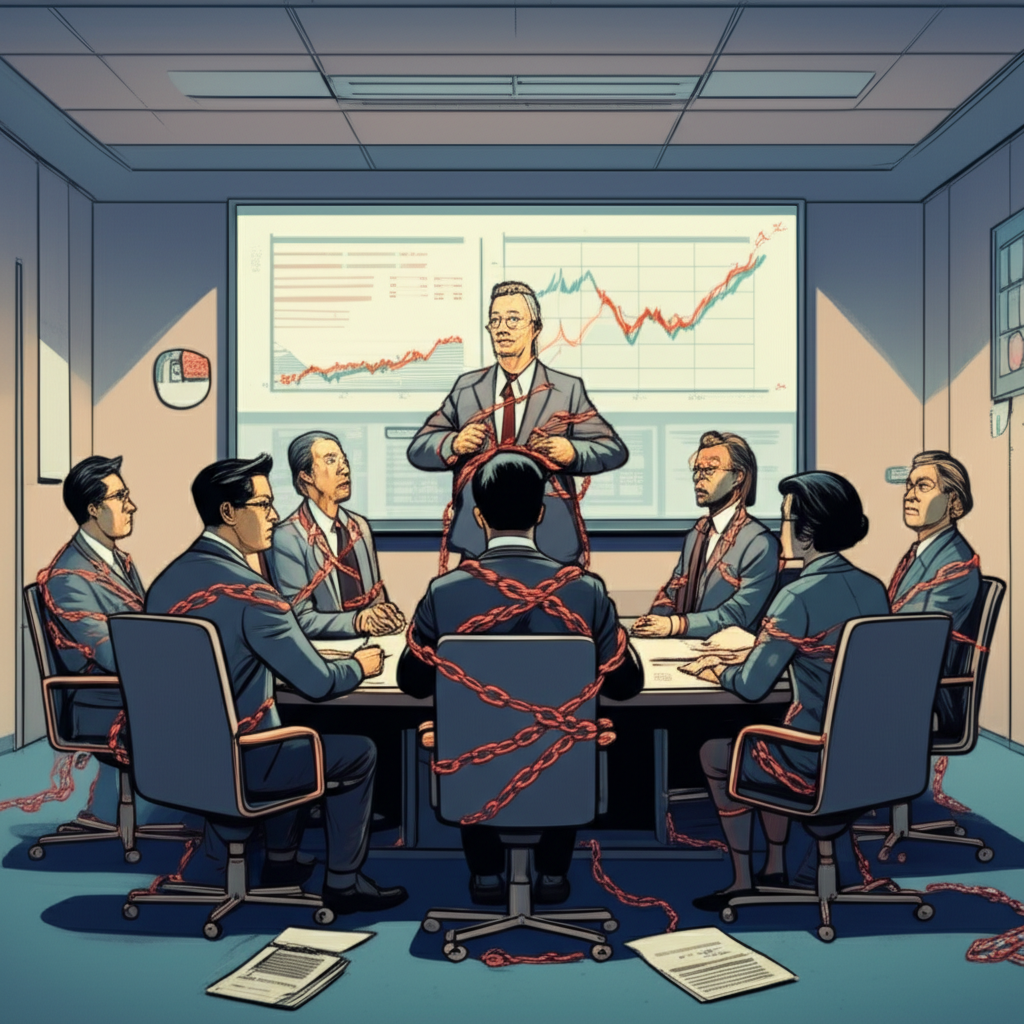
The decision we are addressing is: “Why do companies that fail to update their governance design stagnate, even as their growth phase changes?” This question is critically important as a management decision. Governance design is not a one-time, fixed set of rules. As the business phase changes, the types of risks, the speed of decision-making, and the required level of control inevitably change. If the design remains fixed, governance transforms from a mechanism that supports growth into one that hinders it.
Conclusion Summary (Upfront)
The fundamental reason companies cannot grow is not a lack of talent or strategy, but their failure to update their governance design according to the business phase. The correct design principle is to treat governance not as a fixed set of rules, but as a “designed artifact” with the premise of being updated. This does not mean disregarding rules; it signifies a shift in the design philosophy itself.
Premise Clarification (Facts & Constraints)
The purpose of a business is to optimize the quality and speed of decisions according to its growth phase. Key constraints include differing risk structures between initial and growth phases, and changing control costs as organizational scale changes. Furthermore, past success experiences can potentially become future constraints. Given these premises, failing to update governance design itself can be considered the most significant risk management issue for a company.
Typical Structure of Companies That Cannot Update Design
Companies unable to update their governance design commonly exhibit the following signs:
- Exception handling is continuously increasing.
- No one can explain the background or intent of the rules.
- Operations based on “normally not allowed, but as a special exception” have become the norm.
All of these are clear signs that the current design is not keeping up with the reality of the business.
Ideal Phase-Specific Design
In companies capable of adapting to growth, governance is designed based on the following premises:
- Adjusting decision speed for each phase.
- Gradually transitioning from highly reversible designs to irreversible ones.
- Pre-defining the “triggers” that should prompt a design update.
In other words, excellent governance is not a finished product, but a designed artifact that continues to evolve.
Division of Labor as a Management Decision
Updating governance design requires clear role division. The role of management is to accurately recognize changes in the business phase, decide on design updates, and take responsibility for questioning current rules. On the other hand, the role of the organization and back-office functions (legal, accounting, etc.) is to visualize the distortions and inefficiencies of the current design and propose concrete update plans. The moment design updates are avoided, governance begins to drag down growth.
Common Failure Patterns
There are three main failure patterns that hinder governance updates:
- Fixed-Rule Dogmatism: The mindset that views changing rules itself as a risk.
- Dependence on Past Success: The state of sanctifying a design that worked in the past and being unable to let it go.
- Absence of Update Responsibility: No one takes on the decision and responsibility for design changes.
All of these are signs of covering up problems through operations without fundamentally reviewing the design.
After (The Business Leader After Reading)
Business leaders who understand the content of this article will be able to treat governance as a designed artifact with the premise of being updated. They will positively view changes in the business phase not merely as risks, but as signals to review the design, and will be able to maintain a decision-making structure within the organization that does not halt growth. Consequently, only companies that can flexibly update their governance design can overcome different growth phases and achieve sustainable development.

Comments