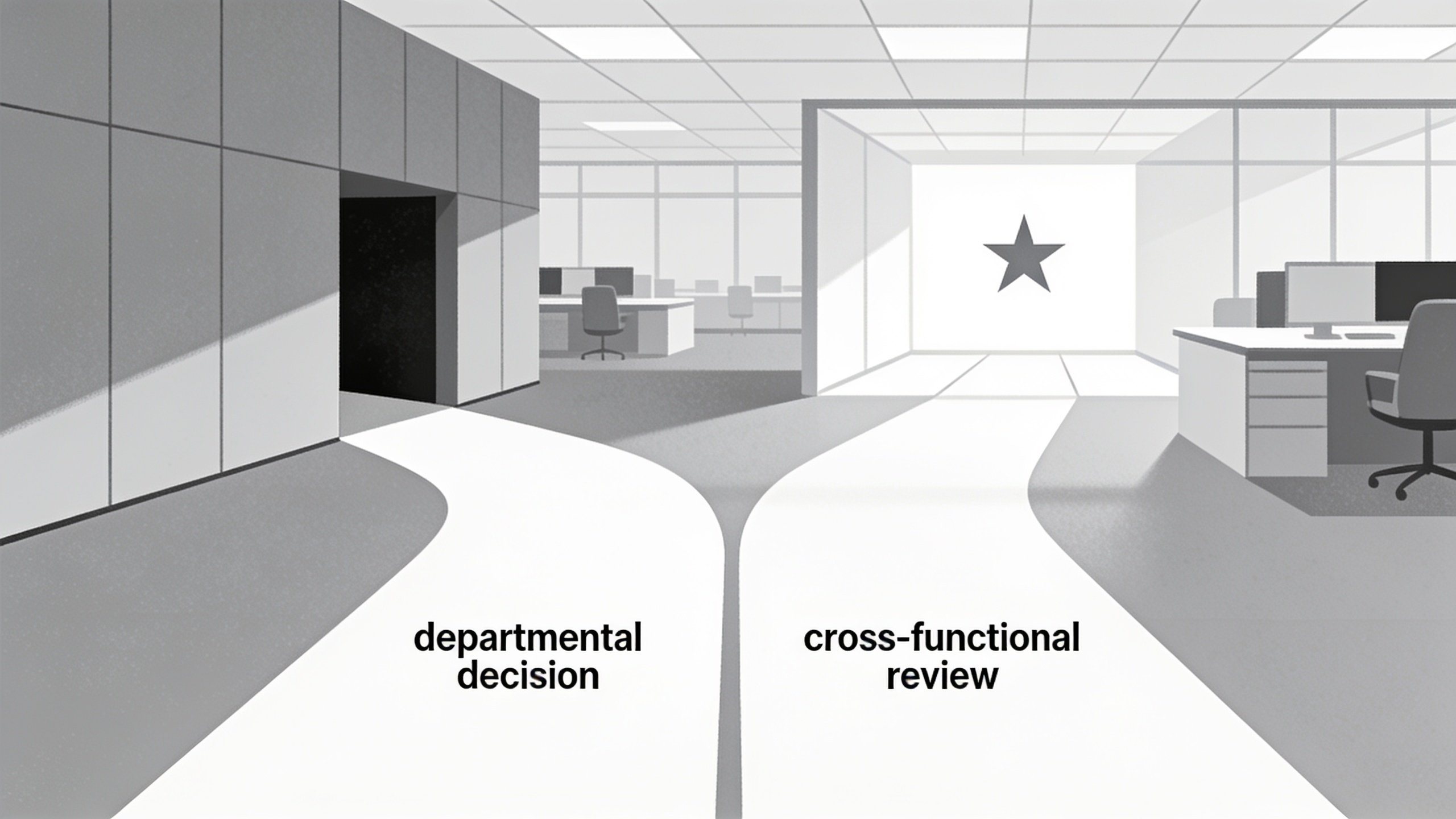
Governance Challenges Triggered by One Department’s Decision
In 2024, controversy erupted when the Self-Defense Forces exhibition booth was canceled at Nagoya University’s “Meidaisai” festival. The university officially apologized, acknowledging “governance issues” in the decision-making process.
At the core of the problem was that the cancellation was decided solely by the relevant department. Without following university-wide policies or procedures, a single department made the call independently, highlighting a failure in organizational governance.
While this may seem like a large university’s problem, it’s actually a highly instructive case for SME owners. The risk of “one department’s decision” damaging an entire organization’s credibility applies regardless of size.
This article analyzes the case as a classic governance failure pattern—”suboptimal decisions undermining overall optimization”—and offers concrete steps SME leaders can apply to their own companies.
Why “One Department’s Decision” Is Problematic
The Trap of Suboptimization
In Nagoya University’s case, a specific department may have deemed the Self-Defense Forces exhibition “inappropriate.” However, from the university’s overall perspective, the goal was to provide a venue for academic discussion and exposure to diverse opinions.
Similar phenomena occur daily in SMEs. For example, an accounting department might pursue the suboptimal goal of “cost reduction” alone, restricting necessary sales activities. While correct from accounting’s viewpoint, it can be wrong from the perspective of overall company revenue growth.
When departments make decisions based solely on their own scope, it can lead to outcomes that contradict the organization’s overall objectives. This is the “trap of suboptimization.”
Risks Hidden in the Decision-Making Process
What was criticized in the Nagoya University case wasn’t the decision’s “content” but its “process.” The decision was finalized within the relevant department alone, without consultation or coordination with higher decision-making bodies or other departments.
In SMEs, it’s not uncommon for a single leader or department head to decide unilaterally. Especially in founder-led companies with strong leadership, decisions are often made without sufficient deliberation or coordination simply because “the president decided.”
Such “personalized decision-making” carries the following risks:
- Information bias: Overlooking risks invisible from a single perspective
- Lack of coordination: Ignoring impacts on related departments
- Lack of accountability: Inability to explain why the decision was made
- Lack of reproducibility: Different decisions could be made under the same circumstances
Three Lessons SMEs Should Learn
Lesson 1: Design the Decision-Making “Process”
Nagoya University’s apology stated there were “governance issues.” This reflects recognition that the decision-making process itself was flawed.
For SMEs, it’s crucial to design the following “decision-making process” in advance:
- What level of decisions should be made by whom, and through what procedures
- A mechanism to incorporate multiple perspectives for important decisions
- Recording decisions to make them verifiable later
Specific actions include:
- Documenting “criteria for important decisions” (categorizing decision levels by amount or impact)
- Reviewing important decisions retroactively at monthly management meetings
- Building a habit of leaving “decision memos” detailing the rationale
Lesson 2: Create a System to “Avoid One-Person Decisions”
The Nagoya University case was problematic because the decision was made within a closed “relevant department” scope. SMEs should check whether leaders or department heads are unconsciously expanding their “decision-making authority” too far.
Consider introducing the following systems:
- A “cross-review” system requiring input from other departments for important decisions
- Incorporating third-party perspectives, such as external directors or advisors
- A habit of listing “who will be affected by this decision” before deciding
Especially for “social” or “ethical” decisions not directly related to business operations, it’s effective to seek expert or external opinions rather than concluding internally.
Lesson 3: Aim for “Revisable Decisions”
In the Nagoya University case, the cancellation decision later became problematic, leading to an apology. If there had been a mechanism to question “Is this decision appropriate?” at the decision stage, the outcome might have been different.
For SMEs, regularly reviewing decisions is recommended:
- Hold a “decision review meeting” every six months to reflect on past important decisions
- Develop a habit of asking, “If the same situation occurred today, would we make the same decision?”
- Regularly check whether the assumptions behind decisions have changed
Especially in areas where social values or laws evolve, past decisions may no longer be valid. Regular review mechanisms are key to maintaining healthy governance.
Concrete Actions Leaders Can Take Now
Action 1: Visualize the Decision-Making Flow
First, make your company’s decision-making process “visible.” Identify the following:
- Who makes what decisions
- Whose approval is needed for those decisions
- Whether decision records are kept
- Who evaluates the results of decisions and how
Visualization highlights issues like “this is too personalized” or “there’s a risk of insufficient coordination here.”
Action 2: Introduce a “One-Step-Back” Rule
Before making important decisions, establish a rule to always take “one step back.” For example:
- “Can this wait until tomorrow?”—pause for a moment
- “Let’s hear what other departments think”—reach out
- List “what are the risks of this decision?”
This “one-step-back” is the simplest and most effective way to avoid the trap of suboptimization.
Action 3: Make Decision “Reflection” a Habit
Set aside time once a month to reflect on important decisions made that month. Discuss these questions with your team:
- Did this decision align with the company’s overall goals?
- Was there a better way to make the decision?
- Would someone else have reached the same conclusion?
By making this reflection a habit, decision quality gradually improves, strengthening overall governance.
Conclusion: Governance Is the Art of Designing “Process”
The Nagoya University case is a classic example of how “one department’s decision” can cause governance failure, regardless of organization size or industry. The key is to design the decision-making “process,” not just the “content.”
For SME leaders, I encourage you to keep these three points in mind:
- Design the decision-making process in advance
- Create a system that incorporates multiple perspectives, avoiding one-person decisions
- Make decisions “revisable” and review them regularly
Governance isn’t about “avoiding violations.” It’s a higher-level management design concept that arranges and integrates rules from an overall optimization perspective to achieve business goals. Designing decision-making processes that avoid suboptimization leads to sustainable growth for SMEs.
Before “one department’s decision” damages your entire organization’s credibility, why not start with a small step today?


Comments