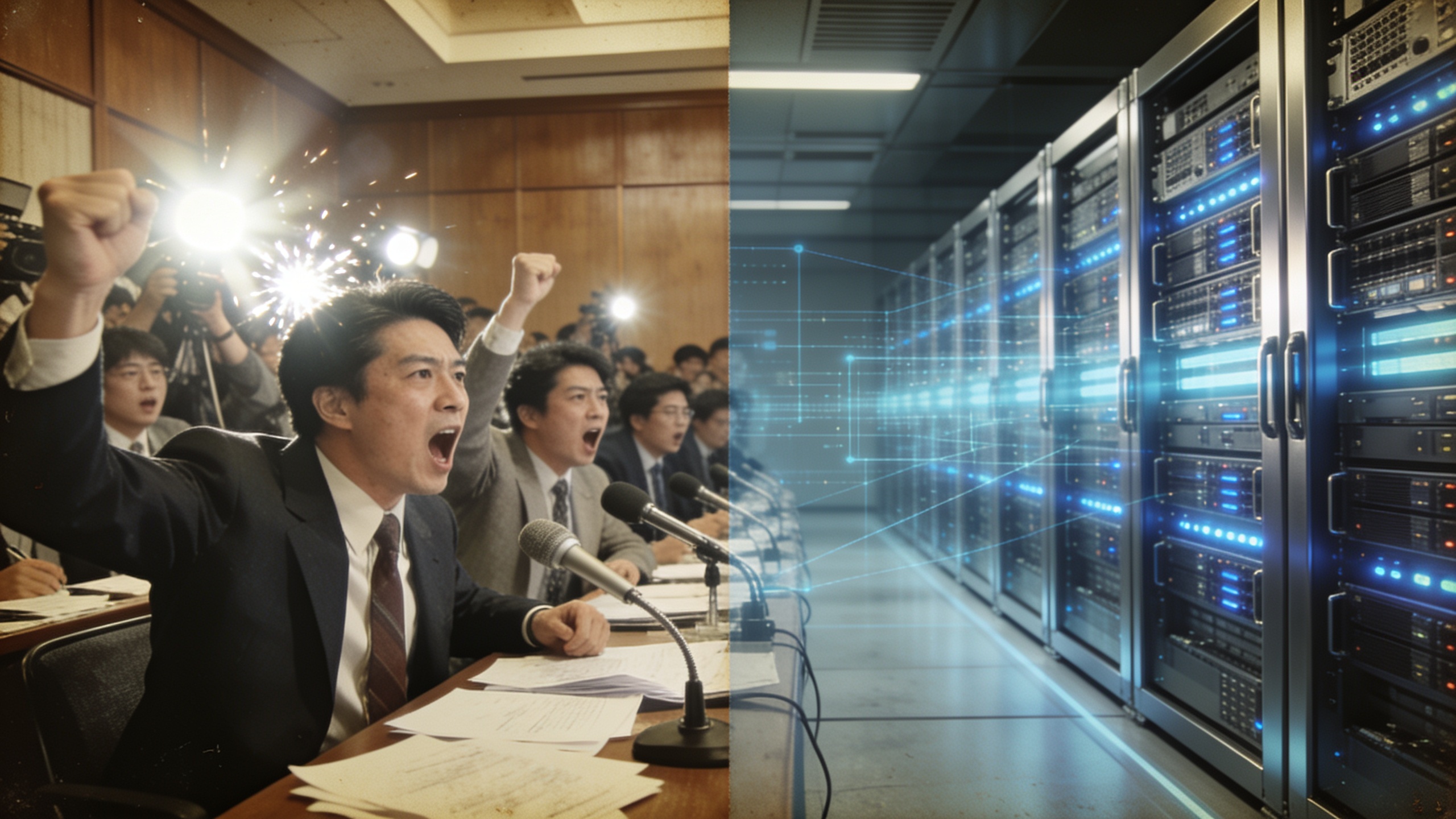
Two News Stories Reveal the “Time Axis of Governance”
Recently, news that Snow Man’s Raul was shocked by the startling realities of Showa-era group interviews went viral. The “comeback techniques” from an era “without compliance,” once showcased by Sanma Akashiya, are now consumed as humorous anecdotes. However, from a corporate governance perspective, this is an extremely insightful case.
This is because, around the same time, an MIT study reported by ITmedia warned that over 10% of AI risks could lead to “catastrophic damage.” The “vibe” of the Showa era and the “AI risks” of the Reiwa era highlight the fundamental truth that the concept of governance must evolve with the times and environment.
This article connects these two news stories and explores how SME managers can apply these lessons to their own governance design.
The Limits of Governance as Taught by the “Era Without Compliance”
The Showa-era group interviews that surprised Raul were filled with remarks and exchanges that would be unthinkable today. Sanma Akashiya’s “comeback techniques” were a skill that perfectly symbolized that era.
However, this isn’t simply a story of “the good old days vs. the bad old days.” The key point is that the governance of that era was optimized for its specific environment.
In the Showa media environment, information dissemination was limited, and the relationship between companies and the media was different from today. Even with low compliance awareness, the risk of a business suffering fatal damage was relatively low.
But in today’s world of social media, where information spreads instantly, past remarks can become a “spark” that significantly damages corporate value. Governance is not a “set of rules to follow,” but a “blueprint that should be updated in response to environmental changes.”
The Trap of “Past Successes” That SMEs Fall Into
Many SME managers are bound by past successes and the feeling that “this worked before.”
For example, verbal contracts, the culture of using personal seals (hanko), and sales processes dependent on specific individuals. These might have been efficient in the Showa era. However, in the Reiwa era, as business partners’ compliance awareness rises and electronic contracts and internal controls become standard, these practices are turning into “governance vulnerabilities.”
The question managers must ask is: “Is our company’s governance optimal for the current environment?”
What the “Catastrophic Damage” of AI Risks Asks of Us
Meanwhile, the MIT study presents an even more serious challenge. The statistic that over 10% of AI risks could lead to “catastrophic damage” supports our media’s fundamental philosophy that risks should be evaluated not as “0 or 100,” but as a continuous scale from “1 to 99.”
AI’s erroneous decisions, data leaks, and discrimination due to bias – these risks, even if their probability of occurrence is low, can threaten a company’s survival once they materialize.
However, many SMEs are failing to even recognize these risks, thinking, “AI has nothing to do with us yet” or “That’s a problem for big companies.”
Why You Need a Design That Assumes “Catastrophic” Scenarios
What the Showa-era “vibe” and AI risks have in common is the question of how to incorporate the “unexpected” into your design.
In the Showa media environment, no one imagined their own words would be spread across the world. Similarly, SMEs introducing AI might not imagine that an AI’s wrong decision could lead to lawsuits or reputational damage.
The essence of governance is not to imagine “every possible scenario,” but to have a “design that allows the business to continue even in the worst-case scenario.”
What SMEs Should Start Now: “Environment-Adaptive Governance”
So, what exactly should SMEs do? Let’s organize the actions we can derive from these two news stories.
1. List and Verify Your Past “Common Sense”
First, identify the customs and rules within your company that are “the way we’ve always done it.” Then, examine them from the perspective of “In the current environment, does this rule increase risk?”
For example, “personnel decisions made solely by the president,” “verbal contracts,” and “vague entertainment of business partners” can become serious governance risks in the modern era.
2. Draw a “Risk Map” Before Introducing AI
When introducing AI, document not only its benefits but also “What happens if it malfunctions?”, “What happens if data leaks?”, and “Who is responsible?” in advance.
As the MIT study shows, even low-probability risks of “catastrophic damage” cannot be ignored. By creating a risk map and deciding on countermeasures before introduction, you can minimize damage in the event of an incident.
3. Establish Communication Rules That Assume the “Unexpected”
Scenes like the Showa-era group interviews can still occur in modern business. For example, posts on social media, casual conversations with customers, or networking events at industry associations. It’s important to periodically review, in response to environmental changes, not just “what you must not say,” but “what you should/shouldn’t say.”
4. Make “Continuous Risk Assessment” a Management Habit
Governance is not a one-time creation. The environment is constantly changing. Once a quarter, include “governance risk inventory” on the management meeting agenda and make it a habit to discuss “Have the types and magnitudes of risks changed compared to last time?”
Governance is Not “Defense,” It’s “Adaptability”
Showa-era humor and Reiwa-era AI risks. These two seemingly unrelated news stories both sound a warning: “Governance that cannot adapt to environmental change will destroy a company.”
What SME managers need is not past successes or the optimistic view that “we’ll be fine,” but the attitude of continuously asking, “Is our company’s governance optimal for the current environment?”
Governance is by no means a “set of rules to avoid violations.” It is a “blueprint for adaptability” to survive an era of rapid change.
Why not start by re-examining the gap between your company’s “Showa” and “Reiwa” practices?
Comments