- Assumed Reader State (Before)
- Agenda Setting (What is the decision?)
- Conclusion Summary (Upfront)
- Clarifying Premises (Facts & Constraints)
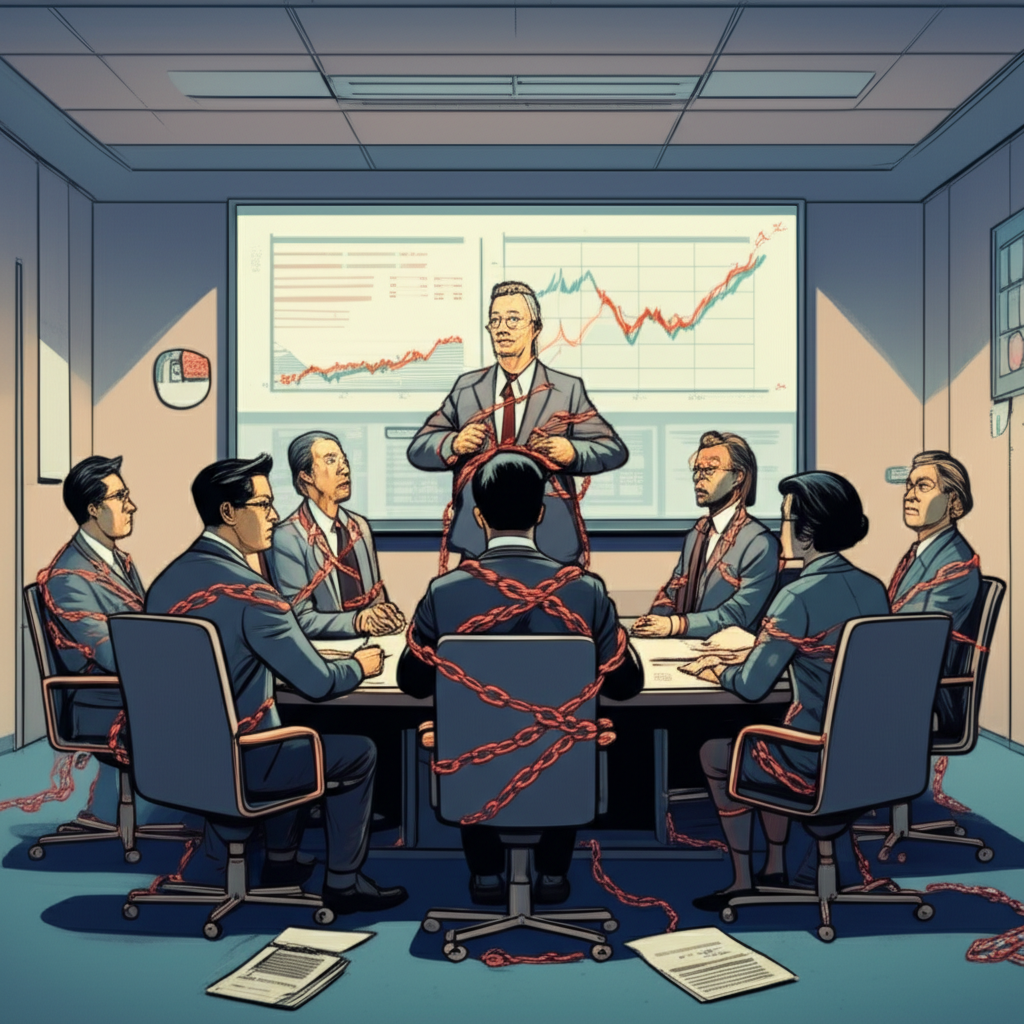
- The Typical Structure Where Governance Stifles Challenge
- The Proper Use of Governance
- Division of Labor as a Management Decision
- Common Failure Patterns
- After (The Leader After Reading)
Assumed Reader State (Before)
You are in a state where new initiatives and challenges are consistently shelved with reasons like “it’s a governance risk,” “controls can’t keep up,” or “there’s no precedent.” While this appears cautious and reasonable on the surface, the reality is that challenges themselves are decreasing. The company avoids major failures but also makes no significant progress. Yet, you convince yourselves that this is “sound management that doesn’t overextend.”
Agenda Setting (What is the decision?)
The decision we are addressing is the question: “Why do companies that use ‘governance’ as a reason to avoid challenges lose their long-term competitiveness?” This is a critical management decision issue. The purpose of governance is not to prevent failure, but to advance the business within an acceptable range of risk. The moment governance becomes a substitute for “reasons not to challenge,” it loses its original role.
Conclusion Summary (Upfront)
A company whose governance stifles challenge is not healthy. The core problem is demanding zero risk without comparing or designing for risk. The correct design principle is to switch from a design that prohibits challenges to one that conditionally permits them. This is not about recklessly encouraging risk, but about making governance function correctly.
Clarifying Premises (Facts & Constraints)
The purpose of a business is to sustain growth even in an uncertain environment. All challenges involve risk, and not taking risks itself creates another risk: stagnation. During growth phases, updating the design of organizational structures and decision-making processes is essential. Given this premise, the decision “we won’t do it because there’s risk” is close to an abdication of judgment.
The Typical Structure Where Governance Stifles Challenge
A common structure seen in many companies is that when a new initiative is proposed, risks are listed from a detailed, siloed perspective, and the proposal is shelved without comparative analysis or conditional design. This is a state where governance is not functioning as a process for comparative risk assessment, far from effective risk management.
The Proper Use of Governance
In functional governance, challenges are handled as follows: Risks are not judged as 0 or 100; multiple execution patterns are compared; conditional execution is permitted; and review triggers are set. In other words, governance is not a device to stop challenges, but a design technology to make challenges viable.
Division of Labor as a Management Decision
The role of management is to decide which challenges to undertake, define the acceptable level of risk, and give the conditional GO. On the other hand, the role of specialists in detailed areas, legal, accounting, etc., is to organize risks and constraints and present specific execution conditions. The moment this division of labor breaks down and specialist input is substituted for a “prohibition,” governance turns into a challenge-suppression device.
Common Failure Patterns
- The Zero-Risk Illusion: The mindset that something must be completely safe to proceed.
- Abandoning Comparison: Failing to present or examine alternatives.
- Precedent Dependence: Rejecting something because it hasn’t been done before.
These are all signs of using governance as a reason to avoid challenge, indicating the hollowing out of corporate governance.
After (The Leader After Reading)
You will no longer treat governance and challenge as opposing concepts. You will be able to design challenges as conditional decisions and build governance that does not halt growth. As a result, governance will become an important management technique for realizing challenges, not an excuse for crushing them.


Comments