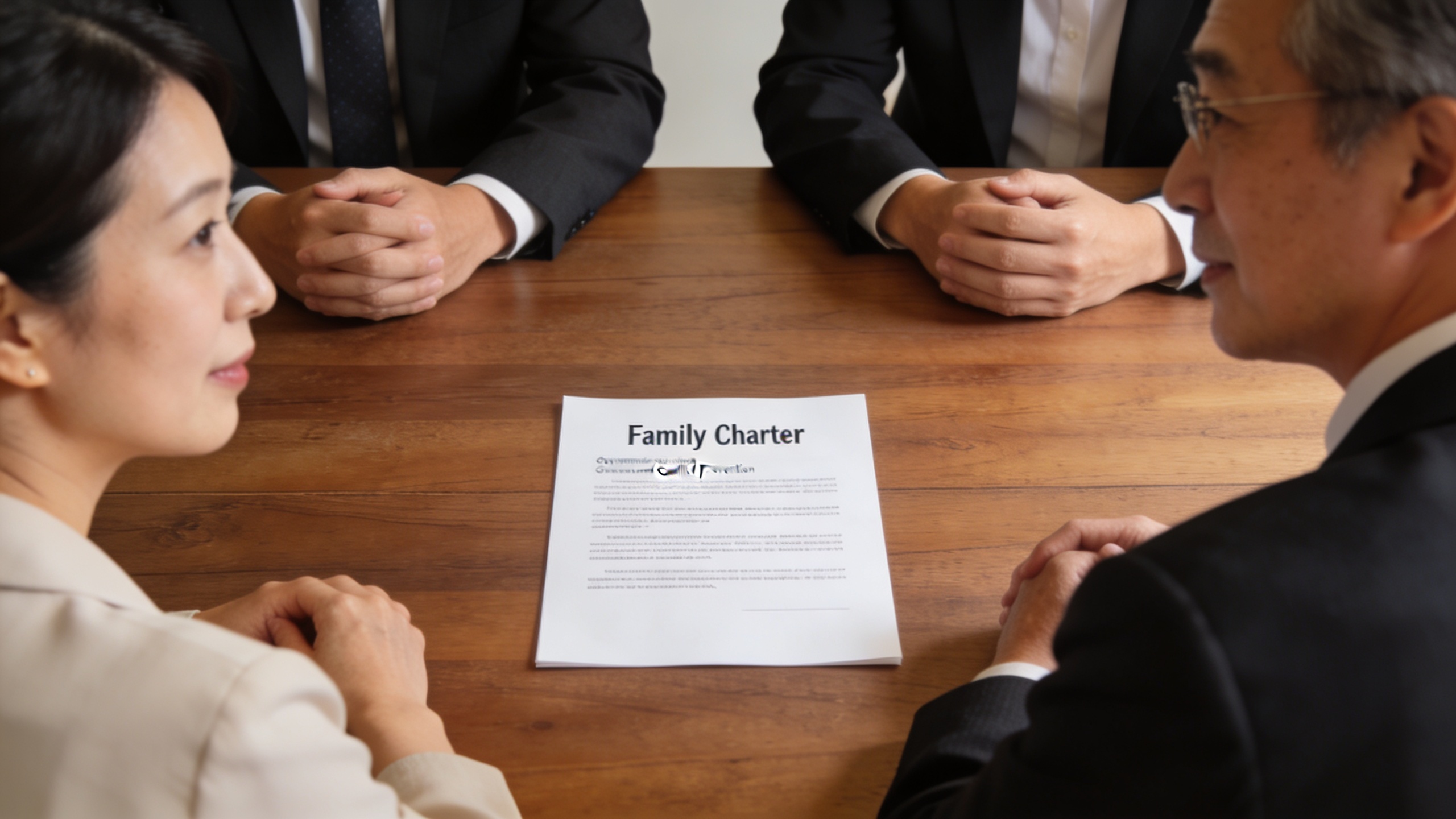
Family Business Risks Can Be Prevented with “Foresight”
Many small and medium-sized enterprises (SMEs) are family-run. Founders and their families have long been at the core of management, driving business growth over the years. However, this “strength of family” can sometimes turn into a “major risk.”
Recently, an article in Toyo Keizai Online titled “How to Prevent Internal Conflict: Lessons from Otafuku Group’s Family Charter” has garnered significant attention. Otafuku Group, a long-established company known for its okonomiyaki sauce, has introduced a “Family Charter” system to proactively prevent internal disputes—a unique risk for family businesses.
This news is far from irrelevant for many SME owners. Have you ever felt a sense of unease in your own company, such as:
- A successor is chosen simply because they are “the founder’s child.”
- Management relies on unspoken understanding among relatives, with no clear rules.
- Discussions about business succession create a heavy atmosphere among family members.
These are all signs of “internal conflict risk.” In this article, drawing on the Otafuku Group case, we’ll share practical steps for designing a “Family Charter” that SMEs can implement.
Three Challenges a “Family Charter” Solves
A Family Charter is a document that outlines the “code of conduct” and “rules” for family members involved in management. It’s not just a set of promises; while it lacks legal binding, it clarifies agreements among family members and prevents future misunderstandings. It’s an extremely practical governance tool.
From the Otafuku Group example, the challenges a Family Charter addresses can be summarized into three main areas:
Challenge 1: Eliminating “Tacit Understanding” in Successor Selection
In many SMEs, there’s an unspoken rule that “the eldest son will take over.” However, it’s not uncommon for the individual to lack the desire or ability. A Family Charter clearly defines successor selection criteria based on “ability” and “intent,” not “blood ties.”
For example, it might include specific requirements like: “To become the top executive, one must have at least 10 years of external work experience” or “After gaining experience in multiple internal departments, approval from the board of directors is required.” This transforms the emotional question of “who will take over” into an objective process of “what criteria must be met.”
Challenge 2: Resolving Ambiguity Around “Money” and “Authority” Among Relatives
In the Otafuku Group case, the charter clearly defines rules for share inheritance and the process for determining executive compensation. In SMEs, gray areas often arise because of family ties, such as “deciding executive compensation among relatives” or “using company cards for personal expenses.”
A Family Charter specifically outlines rules like:
- Rules for share inheritance and transfer (e.g., restrictions on transfers to third parties)
- Process for determining executive compensation (e.g., involving third-party organizations)
- Prohibition of personal use of company assets
- Rules for hiring family members as employees (e.g., educational background and years of experience requirements)
By agreeing on these rules in advance, conflicts over “money” and “authority” can be prevented.
Challenge 3: Preventing “Confusion” After Business Succession
Business succession doesn’t end once a successor is chosen. After the transition, conflicts often arise between the founder (predecessor) and the successor due to differing visions. A Family Charter includes mechanisms to prevent this “post-succession confusion.”
For example, rules like:
- To what extent the founder (predecessor) can remain involved in management as chairman or advisor
- The timing for the successor to gain full management authority (e.g., three years after the founder’s retirement)
- A mediation process for disagreements (e.g., discussions involving a third party)
This helps avoid a “dual power structure” after succession and ensures a smooth management transition.
How SMEs Can Start Creating a “Family Charter” Today
You might think, “We’re not a big company” or “We don’t need something so formal.” However, a Family Charter isn’t just for large corporations. In fact, it’s especially effective for SMEs, where rules tend to be vague.
Here are three steps SMEs can take to get started without pressure:
Step 1: Create a Space for “Discussion”
First, hold regular “family meetings” with all family members involved in management. It’s crucial to hold these separately from management meetings. Management meetings focus on “numbers” like sales and profits, while family meetings are for sharing “family values” and “future visions.”
A good starting point is to discuss “questions without answers,” such as:
- “What kind of company do we want this to be in the future?”
- “What values do we want to protect precisely because we are family?”
- “If we were to choose a successor, what kind of person would be suitable?”
The key is to prioritize dialogue over creating perfect rules from the start.
Step 2: Document “What You’ve Agreed Upon”
Always document the agreements reached in family meetings. Initially, even a simple one-page memo on A4 paper is fine. The important thing is to make things “visible” rather than relying on “verbal promises.”
Key points for documentation include:
- Specificity: Instead of “appropriate compensation,” write something specific like “compensation as a percentage of sales should be within X%.”
- Future-Oriented: Consider not only the current situation but also future changes (e.g., inheritance, successor changes).
- Updatability: Include a clause like “review every X years” to allow for updates as circumstances change.
Step 3: Incorporate “Third-Party” Perspectives
When only family members discuss, issues like “leniency” or “hesitation” can arise. Therefore, seek advice from external experts (e.g., corporate lawyers, tax accountants, SME management consultants) from an objective standpoint.
Third-party input is especially crucial for points like:
- Tax implications related to share inheritance
- Whether successor selection criteria violate laws like the Companies Act
- Whether the process for determining executive compensation could be considered “excessive executive compensation” for tax purposes
By using experts as “tools for rule-making,” you can create a more effective Family Charter.
Conclusion: Prevent Internal Conflict Through “Design”
Otafuku Group’s “Family Charter” is not just a set of rules for a “happy club.” It’s a sophisticated governance design that skillfully “bridges” the emotional bonds of family with the rational organization of a company.
Complacency like “Our family gets along, so we’re fine” creates the biggest risk. Internal conflict doesn’t happen suddenly; it builds up from daily, small “unease.”
Why not start today by simply “talking” in your company? That first step could become the strongest governance to protect your company’s future.

Comments