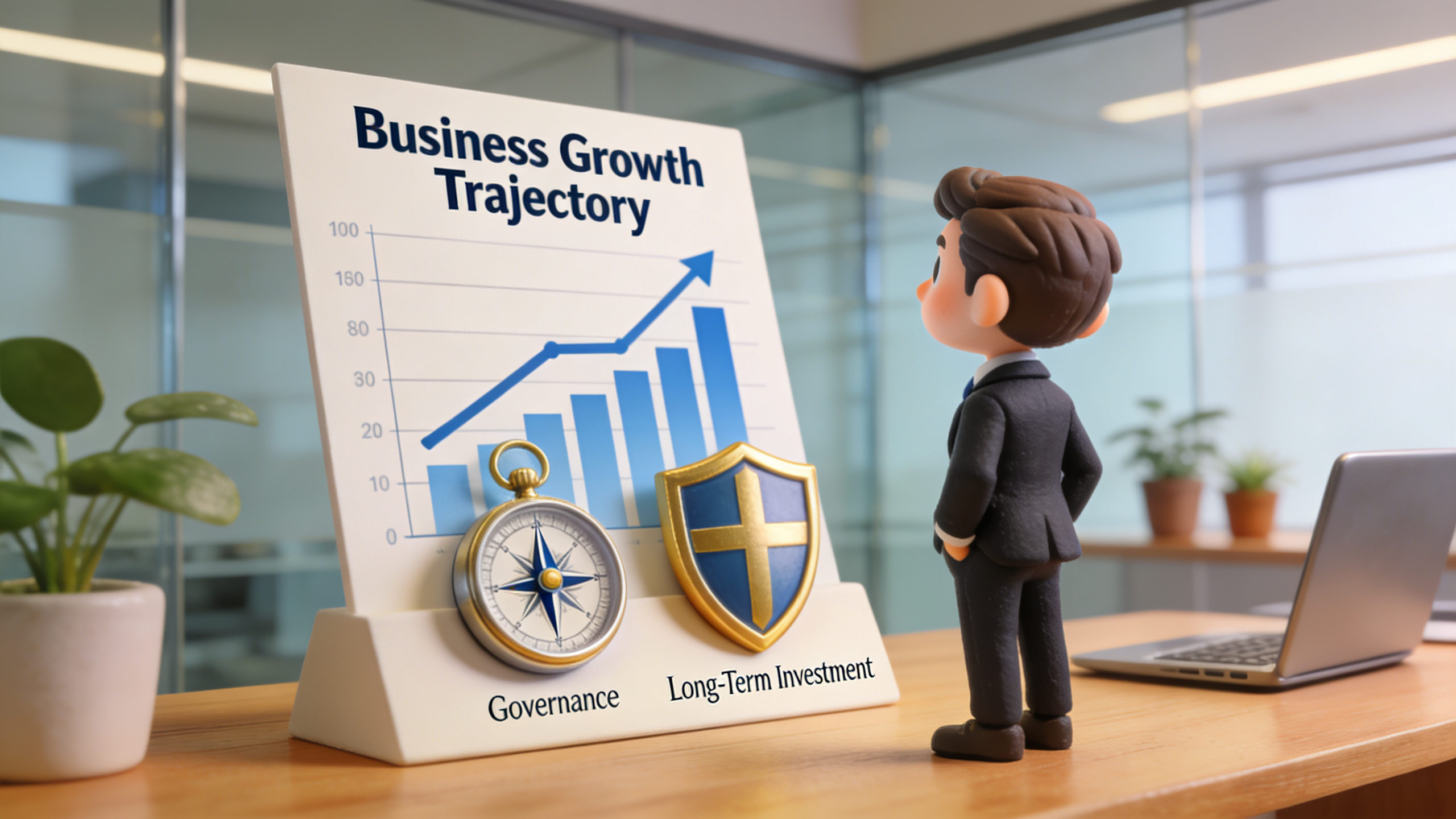
- Warning Against Easy Shareholder Returns: The True Intent of the FSA Official
- Why “Easy Shareholder Returns” Are Dangerous
- Three Common Misconceptions Among SME Owners
- Three Steps to Embed “Mid-to-Long-Term Growth Investment” into Governance
- What the Shift Towards “Explanation-Focused” Governance Guidelines Signifies
- Common Failure Patterns: How to Avoid Them Becoming Pie-in-the-Sky
- Conclusion: Governance is About “Design,” Not “Distribution”
Warning Against Easy Shareholder Returns: The True Intent of the FSA Official
A senior official at Japan’s Financial Services Agency (FSA) has sounded an alarm against “easy shareholder returns” by companies. Behind this lies a strong sense of crisis over the current situation where companies, in their rush to deliver short-term shareholder returns, are neglecting mid-to-long-term growth investments. (Reference: TBS NEWS DIG “FSA official warns against ‘easy shareholder returns’ – urging companies to invest for mid-to-long-term growth”)
This statement carries an extremely important message not only for listed companies but also for the owners of small and medium-sized enterprises (SMEs). This is because SMEs are particularly prone to neglecting investment in the future. When sales increase, it’s natural to think, “First, let’s raise employee salaries” or “Let’s increase dividends to shareholders (owners).” However, if this amounts to nothing more than “easy returns,” the company’s competitiveness will surely be eroded.
Taking this news as a starting point, this article provides a concrete design theory for how SME owners can balance “growth investment” and “governance.”
Why “Easy Shareholder Returns” Are Dangerous
The FSA official’s point strikes at the very “essence of governance.” Governance is not simply about following rules. It is a “higher-level management design concept” for a company to continuously create value.
The dangers of “easy shareholder returns” can be summarized in the following three points.
1. Narrowing Future Options
Reducing retained earnings means reducing the buffer during economic downturns and the funds available for investment in new businesses. As a result, management’s options become limited.
2. Losing the Engine of Growth
If funds for “sowing seeds”—such as capital investment, R&D, and human resource development—are insufficient, the company’s growth will stall. The risk of falling behind competitors increases.
3. Hollowing Out Governance
When a company starts chasing only short-term results like “shareholder returns,” it loses sight of the essence of the business. Governance should be an “offensive” design, not a “defensive” one, but it degenerates into a mere “rule for distribution.”
Three Common Misconceptions Among SME Owners
Based on my experience supporting over 38 SMEs, I find that many owners hold the following misconceptions.
Misconception 1: “Shareholder Returns = Good Management”
The idea that “rewarding shareholders is the manager’s duty” may gain some understanding for listed companies. However, in unlisted SMEs, the shareholders are often the owners themselves. It’s necessary to calmly question whether increasing dividends to oneself truly leads to the company’s growth.
Misconception 2: “Retained Earnings = Bad”
There is a trend that “hoarding retained earnings is stingy management.” However, retained earnings are “savings for future investment.” Without adequate retained earnings, mid-to-long-term growth investment is impossible.
Misconception 3: “Growth Investment = High Risk”
Many owners are unable to take the first step due to the fear that “if the investment fails, the company will collapse.” However, growth investment is not about “taking risks,” but about “designing risks.” The concept of “phased investment”—starting small, verifying, and then expanding—is crucial.
Three Steps to Embed “Mid-to-Long-Term Growth Investment” into Governance
So, how can we specifically incorporate “growth investment” into the governance framework? I propose the following three steps.
Step 1: Decide on the “Golden Ratio” for Investment and Returns
First, formally resolve at the board of directors (or management meeting) the ratio for dividing annual profits into three categories: “growth investment,” “retained earnings,” and “shareholder returns.” For example, “30% of profits for growth investment, 40% for retained earnings, and 30% for shareholder returns.” By deciding this ratio, you can prevent “easy returns” and enable planned investment.
Step 2: Set “Priority Rules” for Investment Projects
Clarify the rules for deciding “what to invest in.” For example, establish criteria like the following:
- Projects with a payback period of 3 years or less are top priority
- Investment in new businesses should be limited to within 10% of existing business profits
- Introduce an internal proposal system to also invest in ideas originating from the front lines
These rules prevent investment decisions from becoming dependent on specific individuals and create organizational consistency.
Step 3: Incorporate an “Investment Verification Process”
Investment is not “done once executed.” A process for regularly checking progress and making necessary course corrections is essential. Conduct an “investment portfolio review” every quarter to visualize the results and challenges of each investment project.
By implementing these three steps, “mid-to-long-term growth investment” will begin to function not just as a goal, but as a part of governance.
What the Shift Towards “Explanation-Focused” Governance Guidelines Signifies
The “Third Revision of the Corporate Governance Code, Shifting from Compliance to Explanation,” reported by Nikkei Business, points in the same direction. (Reference: Nikkei Business Digital “Third Revision of the Corporate Governance Code, Shifting from Compliance to Explanation”)
The ability to logically explain to shareholders and employees “why we are making this investment” and “why we are limiting returns to this level.” This is the essence of what future governance demands. Not “it’s okay because we follow the rules,” but management that can explain “our decision is correct for these reasons” is what can be called true governance.
For SMEs, the parties to whom explanations are due are not limited to shareholders. There are diverse stakeholders, including employees, business partners, and the local community. How to convey the significance of “growth investment” to them. This communication ability will become an essential skill for managers going forward.
Common Failure Patterns: How to Avoid Them Becoming Pie-in-the-Sky
Finally, I will introduce three “common failures” I have witnessed in the field. Avoiding these is the shortcut to success.
Failure 1: The Investment Plan Becomes a “Pipe Dream”
Even if “growth investment” is decided, without concrete projects, the funds will ultimately end up as retained earnings. It is crucial to link the investment plan to specific projects. If there are no projects, first incorporate “exploratory investment” to create projects.
Failure 2: “Explanation” Becomes an “Excuse”
Instead of explaining “why shareholder returns are low,” you need to explain “what kind of value the growth investment will create in the future.” Without a future-oriented explanation, you will not gain stakeholder buy-in.
Failure 3: Bearing the Burden of Investment Decisions Alone
When an owner makes investment decisions arbitrarily, the risk becomes unbalanced. It is effective to create an organization like an “investment decision committee” involving outside directors, advisors, or trusted employees to make decisions with multiple perspectives.
Conclusion: Governance is About “Design,” Not “Distribution”
The FSA official’s warning against “easy shareholder returns” was a reminder of the true essence of governance. Governance is not about how to “distribute” profits, but about how to “design” the company’s future.
Mid-to-long-term growth investment is the core of that design. Instead of rushing into short-term shareholder returns, do not neglect sowing seeds for the future. This is the only path that will ultimately increase corporate value and achieve sustainable growth.
Why not start deciding the “golden ratio of investment and returns” in your company today? That first step will be the first step in the evolution of your governance.


Comments