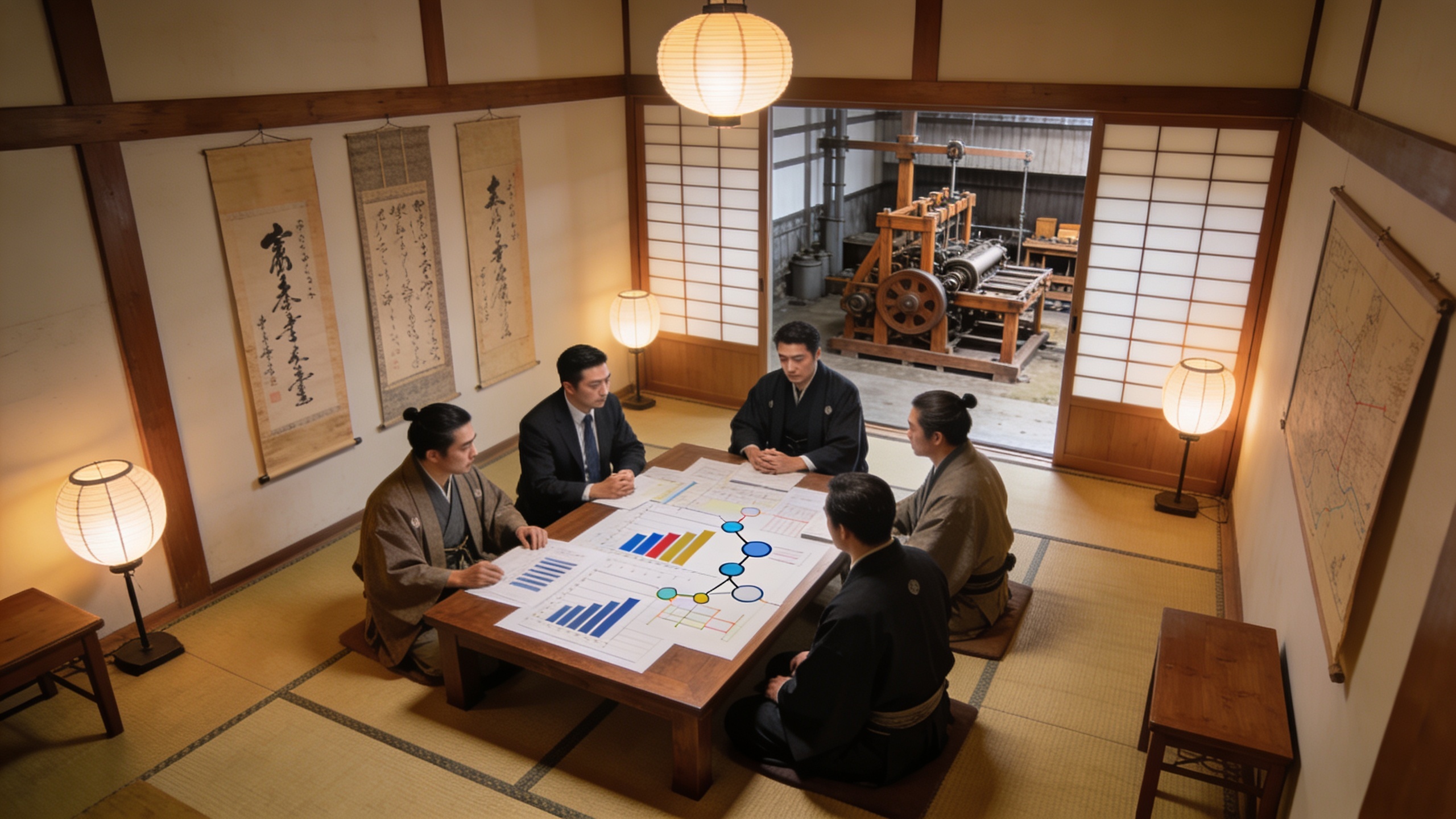
For many SME owners, the word “governance” often feels like something reserved for listed companies or something that requires legal experts. But Japan’s centuries-old business traditions actually hold excellent governance principles that are still relevant today. A JBpress article, “Why Was ‘Mitsui of People’ Born? The Head Clerk-Led Consensus Management and Decentralized Governance by Professional Managers at Mitsui & Co.,” provides a perfect example.
This article extracts governance design tips that SMEs can immediately adopt from the Mitsui family’s head clerk-led consensus management system.
What Is Head Clerk-Led Consensus Management?
After the death of founder Takatoshi Mitsui, the Mitsui family established a consensus-based management system led by head clerks (equivalent to modern professional managers). This was a groundbreaking mechanism to overcome the “founder dependency” challenge common in family-run businesses.
Specifically, multiple head clerks made key management decisions through consensus, spreading the risk of any one person’s arbitrary decisions and ensuring long-term stability. This system can be seen as a prototype of today’s board of directors.
The Risk of “Founder Dependency” in SMEs
Many SMEs tend to concentrate decision-making power in the founder or owner-president. While this can offer speed in management, it also carries the following risks:
・The president’s health or judgment errors directly threaten the company’s survival
・Difficulty in business succession due to lack of successors
・Potential escalation of conflicts within the family
The Mitsui family’s adoption of head clerk leadership was a forward-looking response to these very risks.
Three Actions SMEs Can Take Right Now
So, what can SME owners learn from the Mitsui system? Here are three concrete actions you can implement immediately.
1. Build a System to Cultivate “Head Clerk” Roles Within Your Company
Mitsui’s head clerks were not just employees; they were professionals who could think from the same perspective as the owners. In SMEs, you can cultivate head clerk roles by increasing department heads’ participation in management meetings and sharing the reasoning behind management decisions.
Specifically, start by having department heads attend monthly management meetings as observers, and create opportunities to explain why certain decisions were made.
2. Formalize Consensus-Based Decision-Making Rules
Mitsui’s consensus system was not just an oral tradition; it existed as clear rules. For SMEs, we recommend documenting rules like the following in your employment regulations or board of directors’ rules:
・Major investment decisions (e.g., over ¥5 million / ~$35,000) require a resolution at the management meeting
・New business initiatives require approval from at least three executives
・Clearly distinguish between decisions the president can make alone and those requiring consensus
3. Regularly Incorporate External Perspectives
Mitsui sometimes recruited head clerks from outside the family. For SMEs, it’s crucial to use external experts—such as outside directors, tax advisors, or lawyers—not just as consultants but as a check on management decisions.
In particular, make it a habit to hold a quarterly management review meeting with external experts to add an objective perspective to your decision-making process.
The Essence of Governance That Doesn’t Rely on Experts
The key point here is that Mitsui’s governance “functioned without legal experts.” They achieved stable governance through rules rooted in practical management and by developing people to operate those rules.
A common pitfall for modern SMEs is equating “governance” with “compliance” and outsourcing it entirely to external experts. But truly effective governance must be proactively designed by the owners themselves and operable within the company.
Checklist to Diagnose Your Company’s Governance Level
Check the following items to see if your company’s governance is moving toward the “head clerk-led” model:
・Are major management decisions made by the president alone?
・Is there a culture where department heads can freely express opinions in management meetings?
・Are there multiple successor candidates with a clear development plan?
・Are external experts used as a check on management decisions?
・Are decision-making rules documented and shared with all employees?
If you answered “no” to even one item, it indicates room for governance improvement.
Conclusion: SMEs Should Embrace the “Head Clerk-Led” Philosophy
Mitsui’s head clerk-led consensus management is a governance prototype that modern SMEs should reference. To break free from founder dependency and achieve sustainable management as an organization, start these three actions today:
1. Build a system to cultivate head clerk roles within your company
2. Formalize consensus-based decision-making rules
3. Regularly incorporate external perspectives
Governance is never just for large corporations. SMEs, with their flexible organizational structures, are uniquely positioned to practice smart governance design learned from history.
(Reference: JBpress “Why Was ‘Mitsui of People’ Born? The Head Clerk-Led Consensus Management and Decentralized Governance by Professional Managers at Mitsui & Co.,” May 1, 2025)

Comments