What the News of a Return to Entertainment Asks Us
On April 25, 2026, news broke that Kenshin Uemura, who left the idol group “ONE N’ ONLY” due to a compliance violation, would be resuming his entertainment activities (Livedoor News). It would be a waste to dismiss this as mere celebrity gossip. This is because it offers important insights for governance design in small and medium-sized enterprises (SMEs).
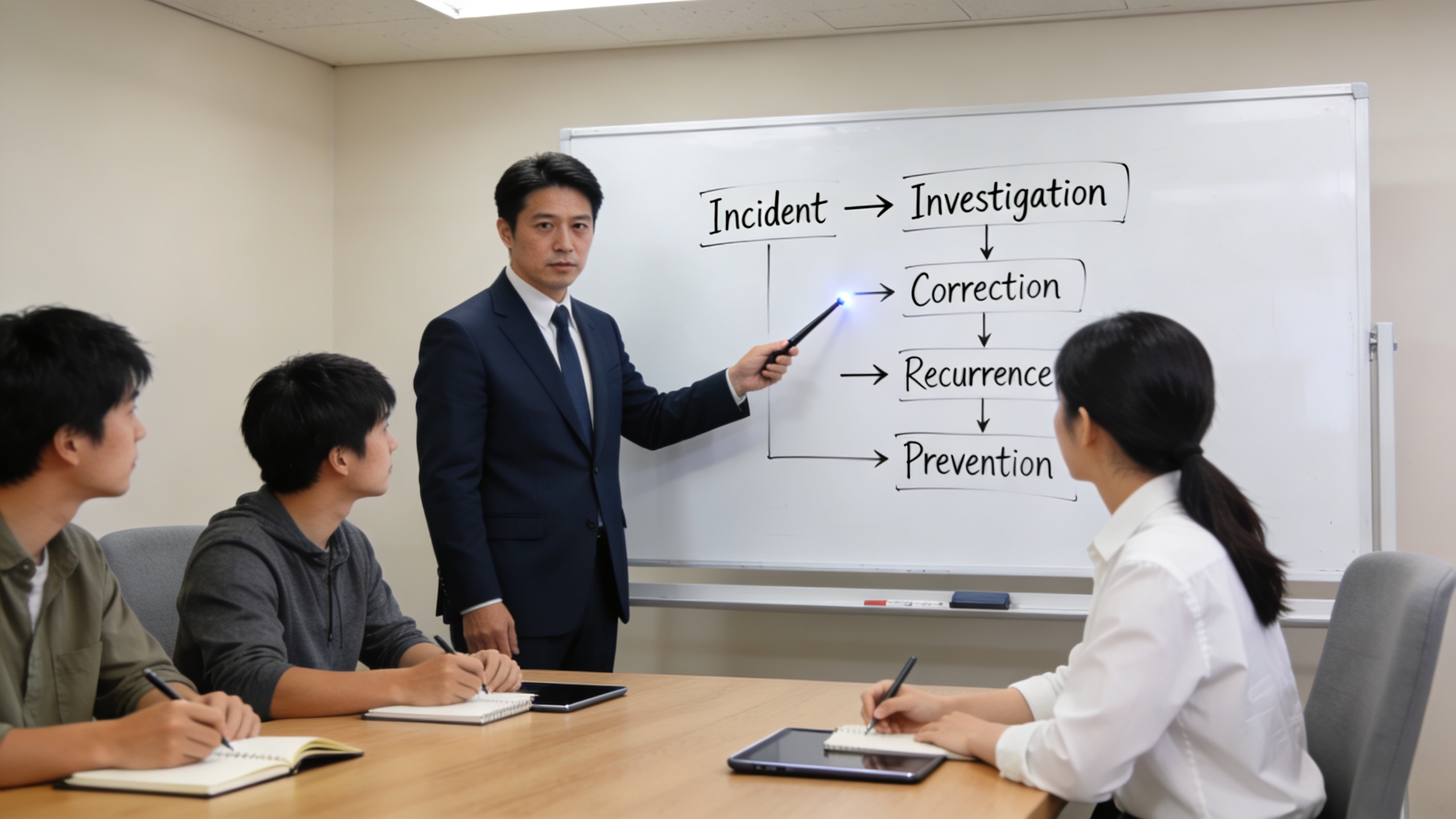
In many SMEs, when an employee commits a compliance violation, it often ends with a disciplinary action. However, when considering the possibility of the violator returning to the workplace, it becomes clear that “discipline” alone is insufficient. To prevent recidivism and strengthen the organization’s overall governance, you need a mechanism to analyze the root cause of *why* the violator took that action and to design their behavior upon return.
The Risk of Recurrence Brought by “Ending with Discipline”
A common pitfall for SME managers is the simplistic equation of “compliance violation = immediate dismissal.” Certainly, this may be appropriate for serious violations or anti-social behavior, but for minor infractions or violations due to a misunderstanding of rules, dismissal is not always the optimal solution.
The key is to reframe the violation not as an “individual’s fault,” but as an “organizational design problem.” For example, in cases like “I didn’t know the expense reporting rules” or “I was just following my boss’s orders,” there is a high probability that the problem lies in the organization’s training system or chain of command. Simply removing the violator won’t solve the issue; if the same structure remains, another employee will likely repeat the same violation.
Three Design Elements Necessary for Preventing Recidivism
When a violator returns, or to prevent recurrence in general, the organization should focus on the following three points.
The first is a mechanism to identify the “root cause” of the violation. Instead of ending with “they didn’t follow the rules,” you need to conduct a multi-faceted analysis asking, “Why couldn’t they follow the rule?”, “Was there a problem with the rule itself?”, and “Did the surrounding environment encourage the violation?”
The second is the design of “behavioral restrictions” and “monitoring” after the return. Instead of immediately restoring all authority, a system that gradually rebuilds trust is effective. This could involve limiting the scope of work for a certain period or strengthening the approval process by a supervisor.
The third is an organizational “learning” mechanism. Individual violation cases should be used to improve company-wide rules and revise training programs. This is nothing less than enhancing the “organization’s learning capacity,” which is the very essence of governance.
Specific Actions SMEs Should Take
So, what should SME managers specifically do? The key is “systematization.”
First, standardize the “investigation process” when a compliance violation occurs. Establish rules in advance for who will investigate, what they will investigate, and how. The investigation items should include not only “fact-finding of the violation” but also “interviewing the circumstances leading to the violation,” “reviewing relevant internal rules,” and “checking for similar past incidents.”
Next, document the preventive measures as an “action plan.” A common failure is ending up with abstract phrases like “strengthen awareness-raising” as the “preventive measure.” You need a system that clearly states “by when, who will do what,” and regularly checks progress.
Finally, set a “follow-up period” after the return. For example, impose specific restrictions such as mandatory weekly meetings with a supervisor for three months, or withholding approval authority for certain transactions. This is not to punish the violator, but a necessary process to reduce the risk of recurrence and restore trust in the entire organization.
Governance is “Design,” Not “Punishment”
This news of a return to entertainment activities highlights not just an individual’s comeback story, but the importance of an organization’s “recidivism prevention design.”
For SME managers, a compliance violation is not a “troublesome fire to put out,” but an “opportunity to review the organization’s design.” Instead of blaming the individual, view the violation as an organizational system issue and design mechanisms to prevent recurrence. This is the fundamental value of governance.
It is no exaggeration to say that whether you adopt the perspective of “changing through design” instead of “ending with punishment” can determine the sustainable growth of your organization.
Source: Livedoor News “Kenshin Uemura, Who Left ONE N’ ONLY Due to Serious Compliance Violation, to Resume Entertainment Activities” (Published April 25, 2026)

Comments