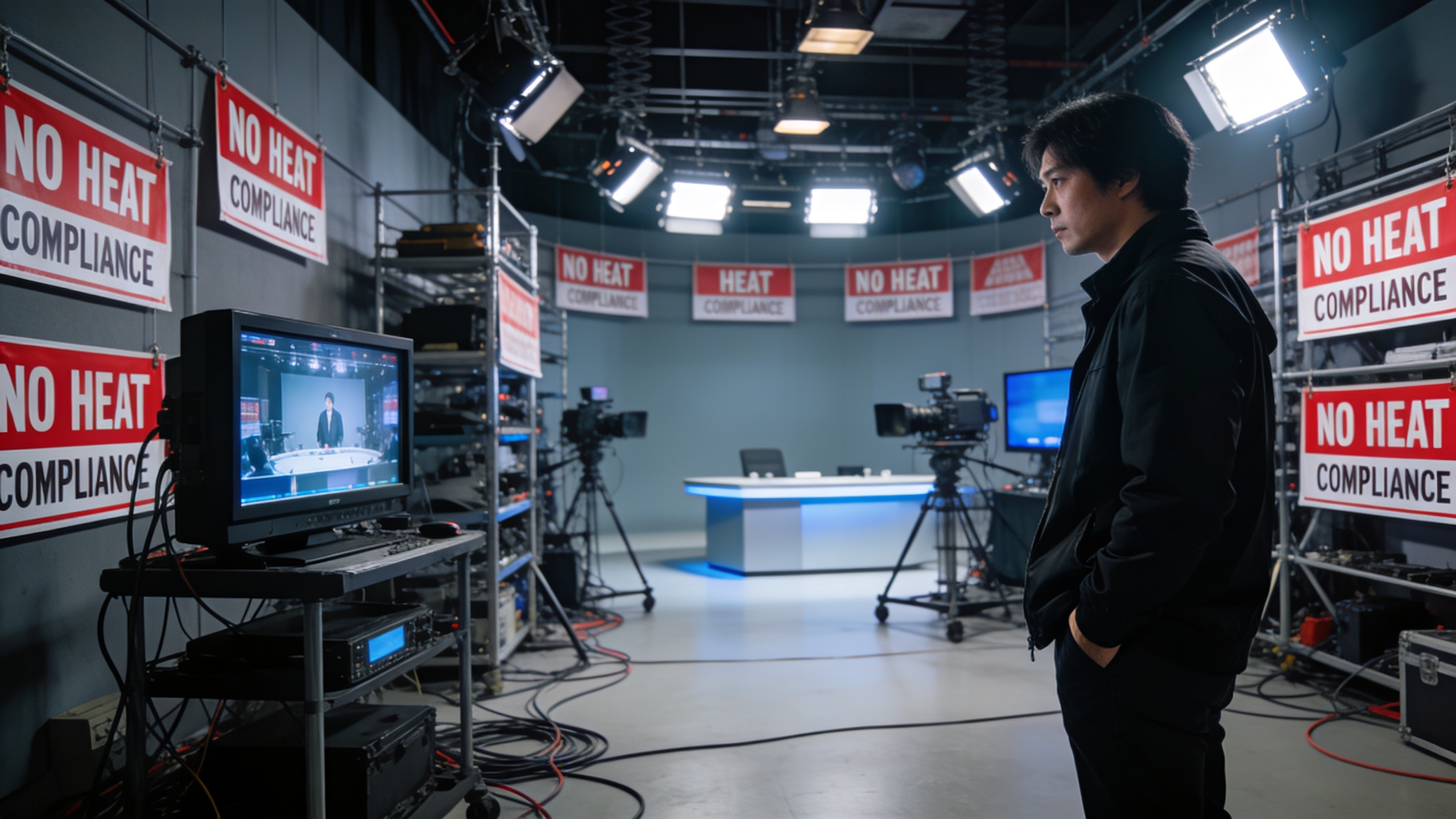
The Word “Atsui” That TV Has Lost
Comedian Tetsuro Degawa recently sparked discussion by revealing on his radio show that he was told, “Please don’t say ‘atsui’ (hot)” due to stricter compliance in the TV industry (source: Nico Nico News).
While it may sound like a joke, this issue is deeply relevant to governance in small and medium-sized enterprises (SMEs). When compliance becomes “excessive,” it robs on-the-ground judgment and stalls an organization’s growth engine. Let’s explore this structure together today.
When Compliance Turns into Prohibition
What’s happening in the TV industry is a shift from “risk avoidance” to “word policing.” The word “atsui” was likely banned out of concern it could encourage burns or accidents. However, this judgment contains a fundamental flaw.
The purpose of compliance is to “achieve business objectives.” The goal of a TV show is to deliver enjoyment and emotion to viewers. Using the word “atsui” to build excitement is, in fact, an essential act. Banning it inevitably diminishes the show’s appeal.
The same thing happens in SMEs. “We’re afraid of complaints, so let’s drop the new service,” “There was trouble in the past, so this transaction is banned,” “The law has a gray area, so reject the entire project.” This “all-or-nothing” thinking quietly narrows an organization’s potential.
The “Thinking-Stopped Organization” Created by a Chain of Bans
In one SME I advised, the general affairs manager championed “compliance strengthening” and distributed a list of prohibited actions to all employees. The list included:
- Prohibition of excessive service to customers
- Prohibition of meetings with suppliers involving meals or drinks
- Prohibition of using the company name on social media
While it seemed safe, the company’s sales dropped by 15% within six months. Why? Because employees became intimidated, thinking “anything I do will get me in trouble,” and stopped offering new ideas or creative customer service. Sales staff lamented, “Even if a client invites us to dinner, we have to refuse.”
This is “compliance run amok.” Rules reduce risk by limiting on-the-ground actions, but they also strip away creativity and agility. If you get the balance wrong, the organization falls into a state of being “safe but unable to produce anything.”
The Answer: A “1 to 99” Risk Design
So, what should be done? The answer lies in the “1 to 99 risk design” approach.
Let’s consider the word “atsui” as an example. This word does carry risk. There are situations where someone who has been burned shouldn’t say “atsui.” However, instead of banning all uses of “atsui,” the correct design is to set conditions like this:
- Avoid using “atsui” in situations where there is a risk of burns or accidents.
- Freely use “atsui” in safe environments like a studio recording.
- If you do use it, make it a rule to confirm there is no danger nearby.
This is the “1 to 99” way of thinking. To reduce risk to zero, you’d have to completely ban “atsui.” But to keep risk within an acceptable range, you can use it flexibly depending on the situation and conditions. This flexibility is the secret to not killing on-the-ground judgment.
3 Actions SMEs Should Implement Today
Here are three things you can start doing in your company starting today.
1. Change “Prohibition Lists” into “Conditional Permission Lists”
Review your current internal rules and rewrite “Do not do X” into “If you do X, you must meet condition Y.” For example, change “Meals with suppliers are prohibited” to “Meals with suppliers are permitted with prior manager approval and a limit of $35 per person.” This alone dramatically increases on-the-ground flexibility.
2. Be Aware of the “Reversibility” of Decisions
A decision to use “atsui” can be reversed later by saying, “Let’s not do it after all.” This is a “highly reversible” decision. In contrast, building a new factory is not easily reversed. The principle is to set compliance rules more loosely for highly reversible decisions and more strictly for low-reversibility decisions. Review your rules based on this criterion.
3. Ask On-the-Ground Staff for the “Reason Behind Their Judgment”
Build a habit of having people articulate *why* they made a particular decision. One of my clients has a company where, during the morning meeting, each person shares one thing they would “dare to take a risk on today.” This helps employees begin to understand the difference between “taking a risk” and “being prohibited.”
Governance is “Design,” Not “Defense”
Degawa’s revelation teaches us a simple truth: “Excessive compliance kills the front line.” As an SME owner, your goal should not be an “organization bound by rules,” but an “organization with judgment.”
Compliance is a tool for achieving business objectives. If the tool becomes the goal itself and hinders the core business, it’s a design flaw. Starting today, take the first step to change your company’s rules from an “all-or-nothing” design to a “1 to 99” design.
Don’t take away the “atsui” from your team. Instead, design a system that allows them to get appropriately “atsui.” That is the true governance required for SMEs going forward.

Comments