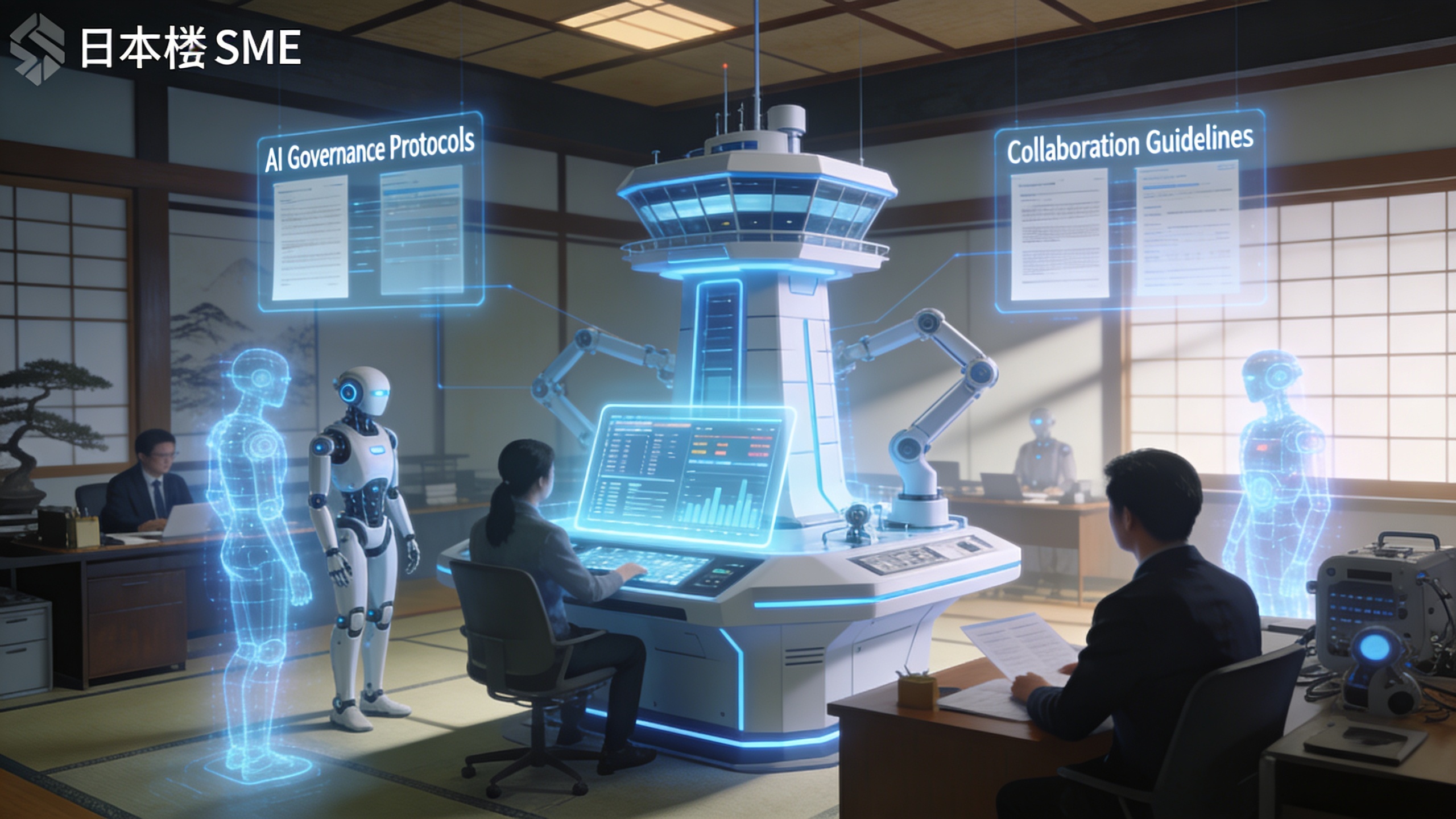
How AI Agents Are Changing the Governance Landscape
“Don’t let AI agents run wild” – ServiceNow’s policy on this matter offers profound insights for small and medium-sized business owners. While allowing AI agents to make autonomous decisions, the company has introduced a strategy centered on an “AI command tower” to oversee and control them (Source: Yahoo! News, “Don’t Let AI Agents Run Wild – ServiceNow Balances Autonomy and Governance with an ‘AI Command Tower'”).
The key point here is that leveraging AI agents simultaneously brings the benefit of “increasing on-the-ground autonomy” and the risk of “creating governance blind spots.” For SMEs, how to design this balance will shape their future competitiveness.
Why AI Agent Governance Matters Now
AI agents are not just simple chatbots; they are systems that autonomously execute tasks and make decisions without human instructions. For example, they are increasingly entering areas traditionally handled by humans, such as automating customer service, optimizing inventory management, and reviewing contracts.
For SMEs, this technology represents a huge opportunity. It directly addresses labor shortages, improves operational efficiency, and reduces costs. However, it also raises a fundamental question: who takes responsibility when an AI makes a wrong decision?
ServiceNow’s case highlights the need for a mechanism that balances AI agent “autonomy” with “control.” The company has built a central management system under the concept of an “AI command tower” that monitors and controls the actions of each AI agent.
Three Common Failure Patterns for SMEs
In my experience supporting numerous companies, failures in governance related to AI adoption are not uncommon. The three most typical patterns are as follows:
Failure 1: “Laissez-Faire” Approach Left to Frontline Staff
This occurs when an AI tool is introduced without clearly defining its decision-making criteria or scope of use, leaving it entirely up to frontline employees. The result is a risk of the AI providing incorrect information to customers or suggesting inappropriate contract terms.
Failure 2: “Dysfunction” from Over-Controlling
Conversely, some companies, fearing risk, set up excessive approval workflows for AI agent decisions. This negates the primary benefit of AI – rapid decision-making – and effectively leaves the company in a situation no different from having humans review everything.
Failure 3: “Black Box” from Over-Reliance on Technology
When the AI’s decision-making process becomes a black box, it’s impossible to explain why a particular conclusion was reached. This poses a significant risk, especially from the perspective of “accountability” required by financial regulators.
Three Key Points for Designing an “AI Command Tower”
Drawing from ServiceNow’s example, here are key points for SMEs to design their own “AI command tower.”
Point 1: Clearly Define “Authority” and “Scope” of Decisions
Clearly outline which decisions AI agents can make autonomously and which require human approval. For instance, routine customer inquiries can be handled by AI, but changes to contract terms or complaint handling should be decided by humans.
Point 2: Build in Monitoring and Recording Mechanisms
Create a system that logs all decisions and actions taken by AI agents for regular review. ServiceNow’s “AI command tower” is designed to centrally monitor each agent’s actions and issue immediate alerts if any anomalies are detected.
Point 3: Establish a Process for Regular “Review”
The decision-making criteria and authority scope for AI agents are not set in stone. A process for regular review based on actual operational results is essential. For example, this could involve verifying the AI’s decision accuracy quarterly and updating rules as needed.
Concrete Action Plan
Here are three actionable steps SME owners can take right now.
Action 1: Create an “AI Agent Usage Manual”
First, create a list of all AI agents used in your company. For each one, develop a manual clearly stating “what it is allowed to decide” and “what it is not allowed to decide.” This serves as a foundation for employees to use AI confidently.
Action 2: Appoint a Person to “Monitor” AI Decisions
Designate a person responsible for regularly checking the actions of AI agents. This person doesn’t need deep technical knowledge of AI. The key is understanding the business impact of the AI’s decisions and being able to detect anomalies.
Action 3: Clarify “Responsibility” Before AI Implementation
Before introducing any AI agent, be sure to decide in advance “who will be responsible if the AI’s decision causes a problem.” This is crucial not only for mitigating legal risks but also for creating an environment where employees feel safe using AI.
Conclusion: Governance as a Source of Competitive Advantage in the AI Era
As ServiceNow’s case demonstrates, balancing AI agent autonomy with governance is an essential requirement for business management going forward. Especially for SMEs, which have more limited resources than large corporations, efficient governance design is critical.
Neither the optimistic view of “AI will handle it, so we’re fine” nor the passive approach of “AI is scary, so we won’t use it” is the correct answer. The key is to design a system tailored to your company that maximizes the power of AI while controlling the risks.
Based on my experience helping over 38 companies build governance structures, I can say that excellent governance does not hinder business growth; rather, it acts as an engine that accelerates it. We should approach governance in the AI era with the same mindset.
Why not start by taking stock of your company’s current AI usage and implementing the three actions introduced here? That will be your first step toward winning the competition ahead.


Comments